
The Fear of the Lord: Perspective
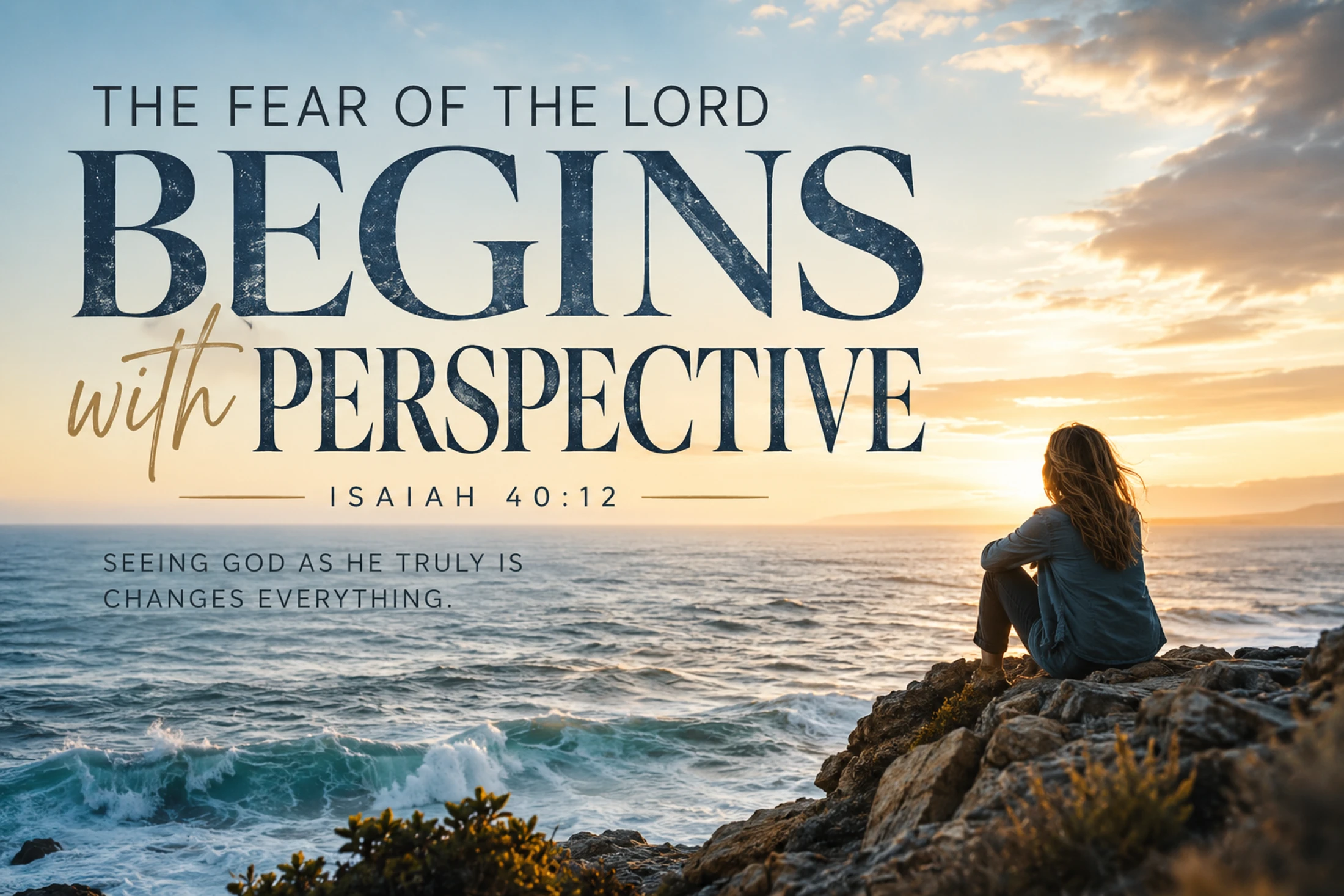
There’s something I've noticed about the fear of the Lord: most of us misunderstand it.
When we hear the phrase "fear of the Lord," we often think of being afraid of God. But that's not what Scripture teaches. The fear of the Lord is much closer to awe, honor, reverence, and proper perspective. For me, one of the clearest pictures of this came when I was about twelve years old. My family took a road trip from New Mexico to San Diego, California. Growing up in the desert, I had never seen the ocean before. As we came over the hills and I saw nothing but blue stretching to the horizon, I was captivated.
The ocean was beautiful, magnificent, and powerful. I remember standing on the shore, watching the waves roll in. At first they seemed playful. The water would wash over your feet and ankles, and you could run from the waves as they chased you back toward the beach. But then you go a little deeper.
Maybe you've experienced it. One moment you're standing confidently, and the next you're slammed into the sand, spinning underwater, disoriented and unable to tell which way is up. The ocean wasn't angry with me. It wasn't punishing me. It simply revealed what it already was: powerful. That experience didn't make me afraid of the ocean. It made me respect it. I still love the ocean. I could sit and watch it for hours. But I learned something important that day: beauty and power can exist together, and power deserves respect.
That's what the fear of the Lord is like.
We Have a Scale Problem
Isaiah 40 gives us one of the most breathtaking descriptions of God's greatness:
"Who else has held the oceans in his hand?" (Isaiah 40:12)
Think about that for a moment. The ocean covers more than 70% of our planet. In its deepest places, it's miles deep. It contains an unimaginable amount of water. And yet Isaiah says God holds it in the palm of His hand. The reason many believers struggle with the fear of the Lord isn't because we're intentionally rebellious. It's because we have a scale problem. We've forgotten how big God is.
Many of us are looking at life through binoculars turned backward. When you look through binoculars the wrong way, everything far away becomes tiny, while everything close to you seems larger by comparison. That's exactly how many Christians view God. God seems distant and small. Our problems seem enormous. Our fears seem overwhelming. Our struggles appear impossible. Why? Because we've lost sight of who God is.
Isaiah 40 reminds us that the God we serve is not small. He is not weak. He is not intimidated by the things that intimidate us. The God who holds the oceans in His hand is not worried about the circumstances keeping you awake at night.
God Is Not Your Side Character
One of the greatest dangers in modern Christianity is that we've made God a supporting character in our story. We are the main character. God is the helper, the emergency contact, the one we call when we need something. But Scripture presents a very different picture. Isaiah writes:
"All the nations of the world are but a drop in the bucket... He picks up the whole earth as though it were a grain of sand." (Isaiah 40:15)
Again and again, Isaiah confronts us with the majesty of God. He sits above the circle of the earth. He calls every star by name. He never grows weary. No one can measure the depths of His understanding. And then, after spending chapter after chapter describing God's greatness, Isaiah tells us:
"Those who trust in the Lord will find new strength. They will soar high on wings like eagles..." (Isaiah 40:31)
Many people love this promise, but they skip the rest of the chapter. They want the strength without understanding the God who gives it. They want God to be their helper more than their King.
The Fear of the Lord Is the Beginning of Wisdom
Proverbs 9:10 tells us that "the fear of the Lord is the beginning of wisdom." Not Bible facts. Not theological knowledge. Not simply reading Scripture. Wisdom begins when we see God for who He really is. When Isaiah encountered the Lord in Isaiah 6, his response wasn't casual. He didn't ask for a blessing. He cried out, "Woe is me!"
When John saw the glorified Christ in Revelation 1, he responded similarly. This was the disciple who had walked with Jesus, eaten meals with Him, and leaned against Him. Yet when he saw Jesus revealed in His glory, John fell at His feet as though dead.
Both Isaiah and John show us what happens when someone truly encounters the majesty of God: awe, humility, reverence, and the fear of the Lord. And if we're honest, this is something many churches are missing today. We love encounters. We love power. We love miracles. But do we truly fear the Lord? Do we honor Him? Do we stand in awe of Him? Or have we become too familiar?
What Are You Beholding?
One of the most important questions we can ask ourselves is this: What am I paying attention to? Because whatever you behold is what you worship. Many of us spend far more time focusing on ourselves than we do focusing on God. Our prayers often reveal it. We spend much of our prayer life asking God to help us, bless us, strengthen us, or fix the situations around us.
Those prayers are not wrong. God cares about our needs. But compare those prayers to the cry of Moses. After witnessing miracle after miracle, Moses' greatest desire was not another blessing. It was not another supernatural display. His prayer was simple:
"Show me Your glory."
The children of Israel wanted God's provision. Moses wanted God Himself. There is a difference. Miracles never built intimacy. The Israelites witnessed miracle after miracle and still struggled to trust the Lord. Jesus performed countless miracles during His earthly ministry, yet many who witnessed them still rejected Him.
Blessings are wonderful. Miracles are wonderful. But they were never intended to become the destination. They are meant to point us back to the One who gives them.
An Undivided Heart
David understood this principle deeply. In Psalm 86 he prayed:
"Teach me your ways, O Lord... Grant me purity of heart so that I may honor you."
Other translations say, "Give me an undivided heart." Why would David pray for an undivided heart? Because our hearts are divided. Part of us wants to serve God. Part of us wants to serve ourselves. We want God's will, but we also want comfort. We want His kingdom, but we also want our own plans.
David recognized something many of us resist admitting: God cannot share the throne of our hearts. The worship belongs to Him. The honor belongs to Him. The glory belongs to Him. The fear of the Lord begins when we stop trying to place ourselves alongside Him and instead recognize Him for who He truly is.
God Wants Relationship
One of the most beautiful truths in Scripture is that God did not create humanity because He needed us. God the Father, God the Son, and God the Holy Spirit existed in perfect fellowship, perfect unity, and perfect love before creation. God was not lacking anything. He created us because He wanted us.
That truth changes everything.
God wants relationship with you. Not because you've earned it. Not because you're worthy of it. Not because He was lonely. He simply loves you. Jesus did not come because humanity deserved saving. He came because God desired us. He wanted us. He still wants us. Too often we reduce God to an assistant, a consultant, or a source of help when life gets difficult. But God desires far more than occasional interaction. He desires fellowship.
He wants us to know Him.
More Than a Self-Help Guide
Modern Christianity can sometimes present God as little more than a self-help guide. We come to Him for advice, encouragement, strength, and solutions to our problems. Certainly God provides those things. But He is far more than that. God is not our cosmic vending machine. He is not simply our coping mechanism when life becomes overwhelming.
He is the Creator of the universe.
He holds the oceans in His hand.
The nations are like dust before Him.
And yet this same God invites us into relationship.
The blessings He gives are not merely gifts to enjoy. They are invitations. Every blessing points back to the Giver. Every answered prayer is God saying, "I see you. I know you. I desire relationship with you." The problem comes when we become more fascinated with the gifts than the One who gives them.
Eternal Life Starts Now
Jesus gives us one of the clearest definitions of eternal life in John 17:3:
"And this is the way to have eternal life—to know you, the only true God, and Jesus Christ, the one you sent to earth."
Notice what Jesus doesn't say. He doesn't say eternal life begins when we die. He doesn't define eternal life as simply getting to heaven someday. He says eternal life is knowing God. Right now. Today.
That has always been God's desire. Not simply that we would know about Him, but that we would truly know Him. The older we get, the more we realize how quickly life passes. Time is fleeting. The years move faster than we ever imagined they would. That is why David prayed, "Lord, teach us to number our days."
Life is short. But eternal life has already begun for those who know Him.
Turning the Lenses Around
The fear of the Lord ultimately comes down to perspective. We've been looking through the wrong lens. We've made our problems too large and our God too small. Isaiah 40 reminds us that the God we serve holds the oceans in His hand. The nations are dust before Him. He calls every star by name. He never grows weary. He never lacks wisdom. He never loses control.
And yet this same God speaks to us.
He knows us.
He loves us.
He invites us into relationship.
The fear of the Lord is not being terrified of God. It is standing in awe of Him. It is remembering our scale. It is recognizing His greatness and responding with humility, honor, and worship. It is loving Him so deeply that obedience becomes the natural response of our hearts—not because we fear punishment, not because we want blessings, but because we never want to grieve the One who loves us with an everlasting love.
May we become people who seek His face and not just His hand.
May we become people who desire His glory more than His gifts.
May we become people who worship Him not merely with our lips, but with our lives.
Because the fear of the Lord is the beginning of wisdom.
And the beginning of truly knowing Him.
Scriptures for Continued Study
Isaiah 40, Proverbs 9:10, Isaiah 6:1-5, Revelation 1:12-17, Luke 12:4-7, 2 Corinthians 4:16-18, Psalms 86:11, 27:4, John 17:3